

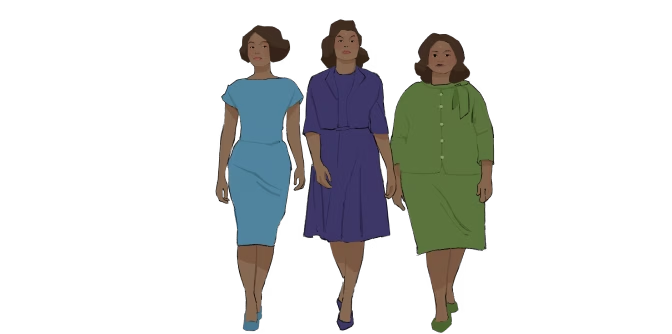
Hidden Figures brought to light
For a long time, the history of science has favored male narratives, leaving in the shadows women who were nevertheless essential to major advances.
Cinema and television series then become powerful tools of rehabilitation, making it possible to make these forgotten figures visible.
The film Hidden Figures (Theodore Melfi, 2016), adapted from the book by Margot Lee Shetterly, is an emblematic example.
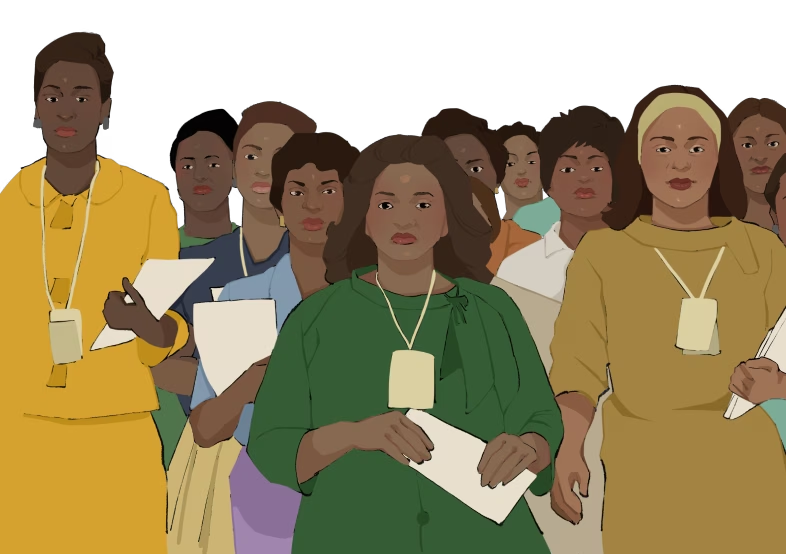
Giving a face to the invisible
Hidden Figures tells the story of three African-American mathematicians, Katherine Johnson, Dorothy Vaughan and Mary Jackson, who played a central role in NASA's space programs in the 1960s.
- Katherine Johnson calculated the trajectories that allowed John Glenn to orbit the Earth.
- Dorothy Vaughan became an expert in programming and team leader.
- Mary Jackson became NASA's first African-American female engineer.
The film highlights not only their scientific genius, but also their fight against sexism and racial segregation.

The power of cinema as rehabilitation
Unlike scientific books or archives, the film reaches a wide audience thanks to emotion, storytelling and embodiment by strong actresses (Taraji P. Henson, Octavia Spencer, Janelle Monáe).
- It humanizes these mathematicians by showing their daily lives, their difficulties and their victories.
- It corrects historical oblivion by restoring their place in the collective imagination.
- It participates in a rewriting of history that finally includes women and minorities.
A model for new generations
By highlighting these women, the film goes beyond simple historical restitution:
- It inspires young girls to pursue science.
- It deconstructs gender stereotypes related to mathematics and research.
- It reminds us that scientific progress is the result of collective and diverse work, often obscured by official narratives.