


Popularization of Her Theory
When we mention the American space conquest, names like Neil Armstrong or John Glenn often come up. Yet, in the shadows, a woman marked this history with her genius for numbers.
Katherine Johnson developed and applied essential mathematical theories for trajectory calculation.
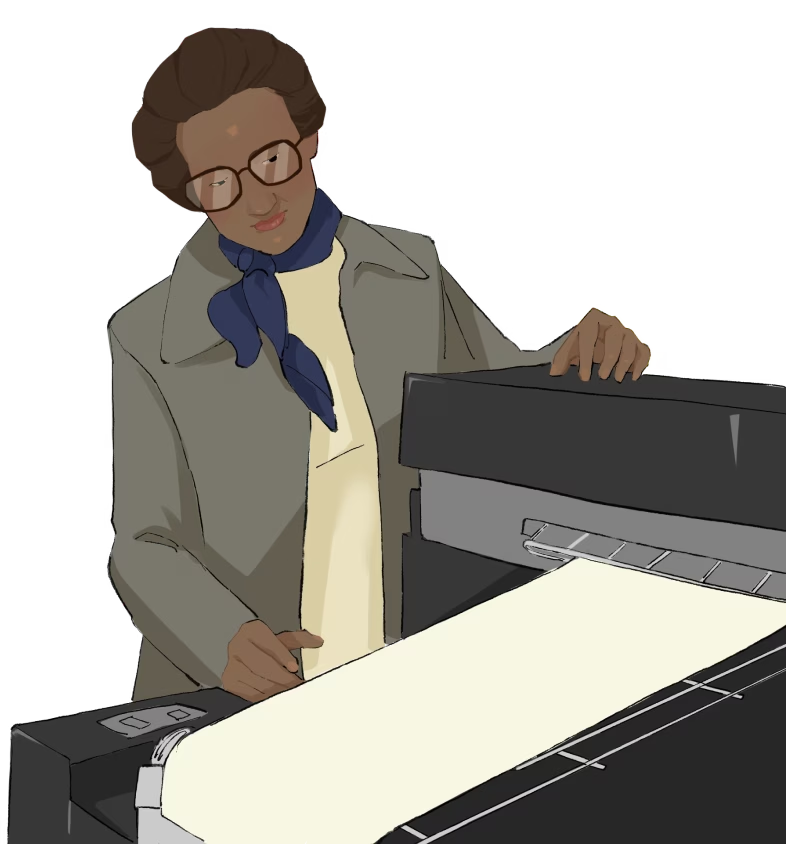
Her skills were based on
- Orbital analysis: understanding and predicting the movement of objects in orbit around the Earth.
- Applied differential equations necessary to anticipate variations in speed and direction of spacecraft.
- Celestial mechanics discipline that consists of accurately calculating launch, entry and return trajectories to Earth.

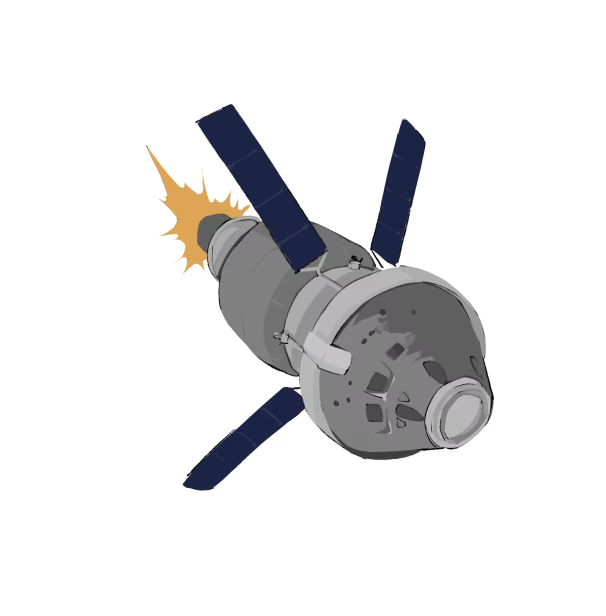

At a time when electronic computers were still in their infancy, Katherine Johnson was able to combine scientific rigor and intuition. Her calculations were so reliable that the astronauts themselves sometimes refused to take off without her validation.
What she achieved
Her contributions resulted in major advances:
- The Mercury-Atlas 6 mission (1962): John Glenn, the first American to orbit the Earth, expressly requested that Katherine Johnson verify the computer's calculations before his flight.
- The Apollo missions: she participated in the development of the trajectories that allowed Apollo 11 to land on the Moon in 1969 and return to Earth safely.
- The Space Shuttle and the Earth Resources Satellite program later, she also contributed to calculations related to new generations of space missions.

A lasting legacy
Katherine Johnson did not just put numbers on paper. She demonstrated that scientific rigor could change history.
Her work realized the American dream of space and paved the way for new generations of scientists.
Even today, her name is synonymous with excellence, precision and perseverance. She embodies the transition from mathematical theory to the concrete reality of space flights.